Typst Package
Cmash Typst — Feature Overview
The compilation engine: turns templates into print-ready PDF, PNG and SVG — with fonts, snippets, batches and PDF/X-4 finishing.
What Is Cmash Typst?
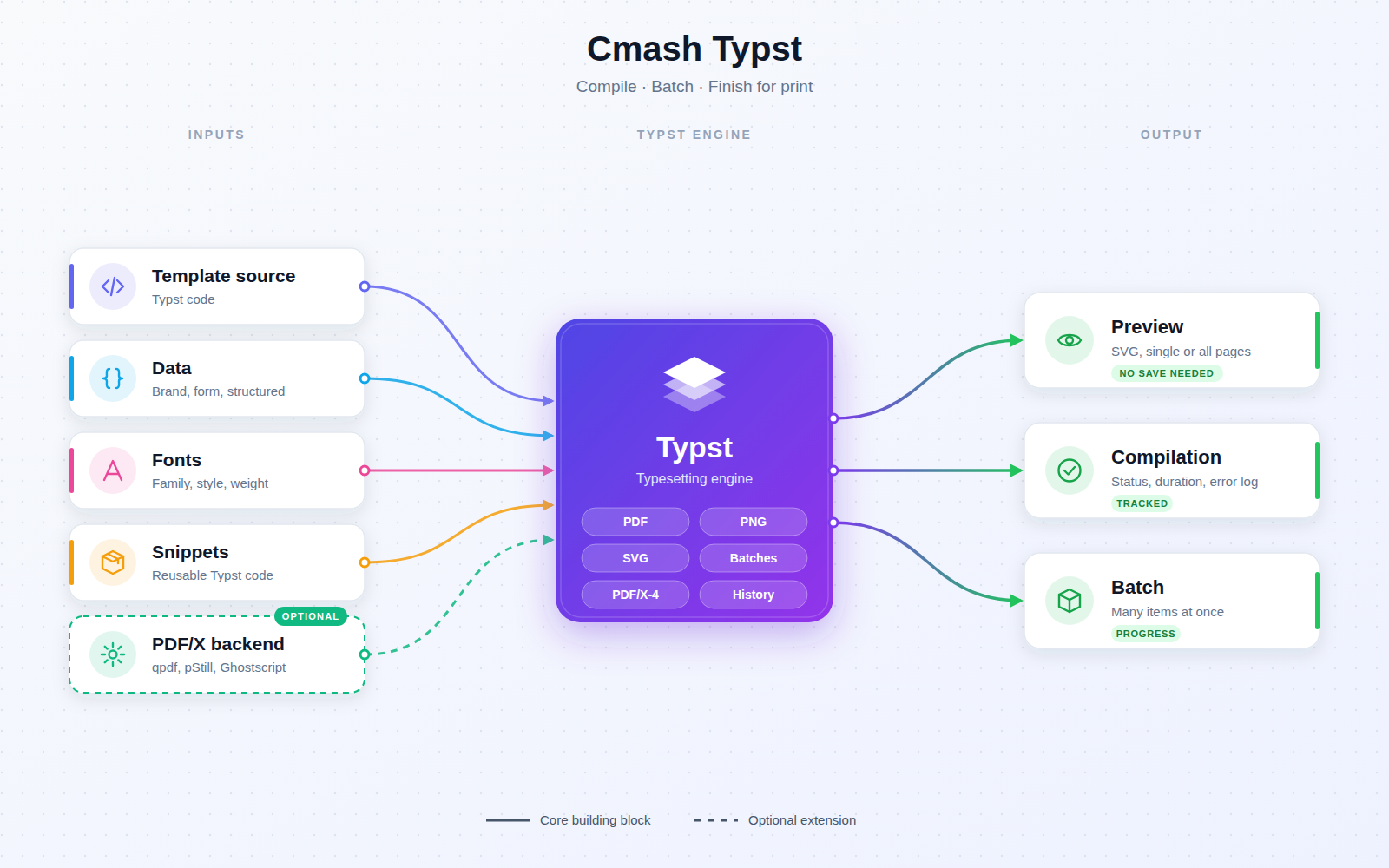
Cmash Typst compiles Typst templates into finished documents. It injects brand data and user input, resolves assets and fonts, and keeps a complete history of every compilation. It also provides the font library and the reusable snippet library, and can produce print-ready PDF/X-4 output.
Key Features
Compilation
- Output formats — PDF, PNG, SVG.
- Preview compilation — SVG, single or all pages, for editors without saving a record.
- Full compilations — with status (pending, compiling, completed, failed), duration, error log and downloadable output.
- Clean build per run — every compilation works in its own temporary directory.
- Data injection — brand variables, form values and structured data are handed to the template.
- Package export — export the compiled source with its resources.
- Diagnostics — errors are captured per compilation.
Batches
- Compile many items at once — a batch tracks total, completed and failed items and total duration, is linked to a project and renderer, and can be downloaded as one assembled PDF (pages are merged with qpdf).
PDF/X-4 for Print
- Finishing — Typst produces the PDF; qpdf then stamps the OutputIntent, page boxes and XMP identification, followed by a preflight whose result is shown per compilation.
- Consistent colour — the printing condition comes from the asset variant type used by the renderer; an explicit override profile can be set on the renderer and is always recorded in the report.
- Non-destructive — nothing is colour-converted or flattened by this step.
- Alternative backends — pstill and Ghostscript can be enabled.
Fonts
- Font library — upload font files, set family, style (normal/italic) and weight (100–900), and generate a specimen preview.
- Multilingual names are supported.
Snippets
- Reusable Typst code — categories: Layout, Typography, Table, Chart, Header/Footer, Utility, Other.
- Automatic availability — active snippets are available in every compilation as
snippets/<slug>.typ; the sharedcmash.typlibrary is available alongside. - Blueprint snippets are seeded.
Integrations & API
Filament resources in the Typst navigation group: Compilations, Compilation Batches, Fonts, Snippets. REST API (Sanctum):
| Endpoint | Description |
|---|---|
/typst/fonts |
Fonts |
/typst/snippets |
Snippets |
/typst/compilations |
Compilations |
Permissions & Dependencies
- Requires PHP ^8.3, ext-zip, Filament ^5, Sanctum, spatie/laravel-translatable and CMAsh packages cmash, cmash-asset, cmash-userasset, cmash-brandkit, cmash-datadefinition, cmash-template, cmash-code-editor.
- Server binaries — the typst binary and, for PDF/X and batches, qpdf (optional: pstill or Ghostscript).
- Uses
cmash-addons.local_packages_pathfrom the platform for local Typst packages. - No package-specific roles or permissions.
Configuration
Config file: config/cmash-typst.php
| Key | Environment variable | Default | Meaning |
|---|---|---|---|
binary |
TYPST_BINARY |
typst |
Path/name of the Typst executable. |
timeout |
TYPST_TIMEOUT |
60 |
Max seconds for one compilation. |
batch_output_timeout |
CMASH_BATCH_OUTPUT_TIMEOUT |
120 |
Max seconds for assembling a batch (qpdf page merge). |
pdfx.backend |
CMASH_PDFX_BACKEND |
qpdf |
PDF/X finishing backend: qpdf, pstill, ghostscript. No automatic fallback. |
pdfx.qpdf_binary |
QPDF_BINARY (or CMASH_QPDF_BINARY) |
qpdf |
qpdf executable. |
pdfx.qpdf_timeout |
QPDF_TIMEOUT |
120 |
qpdf timeout in seconds. |
pdfx.pstill_binary |
PSTILL_BINARY (or CMASH_PSTILL_BINARY) |
pstill64 |
pStill executable. |
pdfx.pstill_enabled |
CMASH_PDFX_PSTILL_ENABLED |
false |
Enable the pStill backend. |
pdfx.ghostscript_binary |
GS_BINARY (or CMASH_PDFX_GHOSTSCRIPT_BINARY) |
gs |
Ghostscript executable. |
pdfx.ghostscript_enabled |
CMASH_PDFX_GHOSTSCRIPT_ENABLED |
false |
Enable the Ghostscript backend. |
Use Cases
- Print-ready production — PDF/X-4 output with preflight results per compilation.
- Live previews — SVG preview compilation while editing templates.
- Mass production — compile a batch of personalised documents and download one merged PDF.
- Brand typography — manage the font library centrally.
- Reusable building blocks — share headers, tables and charts as snippets across templates.
Cmash Typst: from template to print-ready output.